
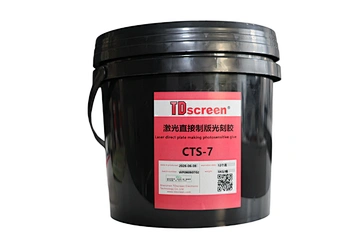
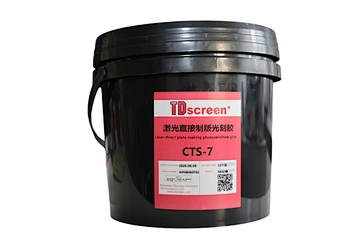
TDS Laser Plate-making Photoresist Emulsion
CTS-7 Photoresist for Laser Screen Making Product Specification
Model | CTS-7 Photoresist |
Appearance | Blue milky liquid |
Packaging | 1L plastic bottle / 5L plastic pail |
Solid Content | 38%; Viscosity: 7500–8500 cps @25°C |
Application | Screen making for PCB, FPC, glass window, LCD, garment screen printing, heat transfer & water transfer sticker printing. General-purpose laser direct exposure emulsion with high solid content, medium viscosity, excellent resolution, water and solvent resistance. |
Operation Instructions
- Pre-treatment of screen mesh Degrease mesh with degreaser or roughen mesh surface with mesh abrasion paste.
- Pre-dry screen Dry at 35~40°C (max. 42°C), ambient humidity: 45%~55% for standby.
- Coating Coating options: 2 coats front + 2 coats back, or 3 coats front + 2 coats back. Adjust coating times to reach target film thickness per printing requirements. - Character printing: 3–5 μm - Circuit printing: 6–8 μm - Solder mask printing: 10–12 μm
- Intermediate drying Dry at 35~40°C (max. 42°C, humidity 45%~55%) for 25–30 mins; adjust drying time based on oven condition. Ensure full drying.
- Exposure
Calibrate exposure energy with exposure test strip.
If no test strip available, test multiple energy levels on one screen and confirm optimal value via developing result.
After exposure, soak both sides of screen with water for 1 min, then rub non-image area on ink side by hand for judgment:
- Smooth & firm surface, no emulsion residue on hand = proper exposure (300 mesh white screen, 2–3μm film, 100μm line develops perfectly; line width hits 100μm measured by digital microscope after drying).
- Soft surface with blue emulsion staining on hand = under-exposure, increase exposure power.
- Hard surface but difficult development, insufficient line width after drying = over-exposure, reduce exposure power.
- Periodically inspect and adjust exposure energy: Low exposure leads to poor solvent resistance & short print run; over-exposure reduces resolution.
- Developing Wet both screen sides and rest for 1–2 mins. Spray printing side with low-pressure fan-shaped water until patterns fully emerge. > Note: Focus flushing on printing side; excessive washing on ink side causes pinholes and jagged edges. Keep water gun ~60cm away from screen. Gently rinse ink side for 1~2 mins, then flush residual residues thoroughly from both sides.
- Final drying Dry at 35~40°C (≤42°C, humidity 45%~55%) for 25–30 mins.
- Inspection & repair; Secondary supplementary exposure is available for longer print durability.
- Mesh sealing
Storage & Usage Precautions:
- This product is presumed harmless to the environment, slightly soluble in water and non-flammable.
- The hazardous property of this product is considered limited. It may cause slight irritation upon skin contact, with limited inhalation hazard under normal working temperature.
- First-aid measures for different exposure routes:
Inhalation: The product is non-volatile.
Ingestion: Rinse mouth thoroughly. Do not induce vomiting. Seek medical treatment if any discomfort appears.
Skin contact: Take off contaminated clothing, immediately wash the skin completely with soap and clean running water.
Eye contact: Remove contact lenses at all times, flush eyes and eyelids with abundant clean water continuously for at least 15 minutes; get immediate medical help if discomfort occurs.
- Personal protective requirement: Ensure adequate ventilation.
- Do not eat, drink or smoke during use.
- Storage:
Potential adverse reactions under abnormal conditions:
Avoid exposure to high temperature or direct sunlight.
Store in cool and shaded place at 5–25℃ with ambient humidity 45%–55%, shelf life is 1 year.
Stir or shake thoroughly to homogenize before use after long-term storage.
Plate-making Effect Drawing: