

TDS 双组份双固化感光胶
CTS-9
数量:
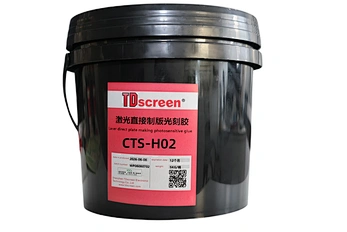
Laser‑Direct‑Imaging Emulsion CTS‑9
Address: No.20 Yunfeng Road, Longhua New District, Shenzhen Tel: 0755‑3553‑1118
1. Product Description
| Item | Specification |
| Product Name / Model | Laser‑Direct‑Imaging Emulsion CTS‑9 |
| Appearance | Blue milky liquid |
| Package | 5L / 6L plastic drum |
| Application | Manufacturing of screen‑printing stencils.Suitable for high‑precision stencil production for glass, touch‑panel (TP), membrane switches, nameplates and other applications. |
| Features | Solid content: 39‑40%; Medium viscosity: 6000‑6500 cps @25 °C;Dry stencil thickness: approx. 3‑5 μm;Resolution on 350‑mesh yellow mesh: 35‑40 μm;Minimum resolution on 420‑mesh yellow mesh: 30‑35 μm;Dual‑resistance to water & solvent;Excellent moisture resistance;Fast exposure speed;Good coating fluidity;High resolution performance;Superior surface Rz value after multi‑layer coating. |
| Storage & Shelf‑life | Store at 5‑25 °C. Shelf‑life: 12 months under ambient condition |
2. Operating Instructions
- Pretreatment of screen mesh Degrease mesh with degreaser, or roughen mesh surface with mesh abrasive paste. Roughening may be omitted for high‑mesh precision stencil making.
- Dry the screen for later use. Dry at 35‑40 °C (max. 42 °C), keep ambient humidity at 45‑55%.
- Coating sequences & drying ‑ Coating: Ink‑side 2 passes + Print‑side 2 passes; Dry: 35‑40 °C (max.42 °C), humidity 45‑55%, 10 min. ‑ Coating: Ink‑side 1 pass + Print‑side 3 passes; Dry: 35‑40 °C (max.42 °C), humidity 45‑55%, 10 min. ‑ Coating: Ink‑side 0 pass + Print‑side 1 pass; Dry: 35‑40 °C (max.42 °C), humidity 45‑55%, 10 min.
The net dry stencil thickness reaches approx. 8 μm. Coating procedure may vary for different industries. Multiple coating passes can achieve target stencil thickness.
- Exposure Determine optimal exposure energy by exposure step‑wedge film. If step‑wedge film is unavailable, test multiple exposure energies on one screen, select suitable energy according to wash‑out result and ease of development. After setting exposure energy, test exposure output periodically and adjust parameters accordingly. ‑ Insufficient exposure: poor solvent resistance and short print run life of stencil. ‑ Over‑exposure: deterioration of resolution.
Allow screen to rest for 1‑3 minutes after exposure.
- Development (Wash‑out) Wet both sides of screen with low‑pressure water (or soak for no more than 1‑2 min), wait 1‑2 min. Spray the print‑side continuously with fan‑shaped low‑pressure water until clear image appears.Note: Focus washing on print‑side. Excessive washing on ink‑side may cause pinholes and degrade edge sharpness. Keep water gun approx. 60 cm away from screen. Then gently rinse ink‑side for 1‑2 minutes. After confirming complete image wash‑out, rinse residual emulsion scum from both sides of screen.
- Post‑development drying Dry screen at 35‑40 °C (max.42 °C), humidity 45‑55%, for 20‑30 minutes.
- Screen inspection & repair For higher print‑run durability, perform post‑exposure (secondary exposure) under standard exposure unit.
- Block‑out the screen.
3. Storage, Handling & Safety Notes
This product is water‑miscible, non‑flammable and has low environmental impact. Hazard potential is limited. May cause mild skin irritation. Inhalation risk is low under normal working temperature.
First‑aid measures
‑ Inhalation: Low volatility under normal use. ‑ Ingestion: Rinse mouth thoroughly. Do NOT induce vomiting. Seek medical attention if discomfort occurs. ‑ Skin contact: Remove contaminated clothing. Wash affected skin immediately with soap and running water. ‑ Eye contact: Remove contact‑lenses. Flush eyes and eyelids continuously with plenty of running water for at least 15 minutes. Seek immediate medical help if irritation persists.
Personal Protection
Ensure adequate ventilation in working area. Do not eat, drink or smoke while handling the product.
Storage
(Store in cool place, avoid high‑temperature and direct sunlight.)